Presentation topic
Olgun discusses the possible influence of deuterium on certain proton-coupled processes. His starting point is a mechanistic question, not a clinical evaluation of water.
How to read the hypothesis
A mass difference between proton and deuteron may matter in highly precise reactions. For biological relevance, the frequency, amplitude, and conditions of the effect must be measured.
Connection to the publication
The separate article on deuteronation and aging summarizes the published work. The oral presentation adds explanations and examples but does not replace verification of the data and methods in the publication.
00–08 min · Mechanistic questions and protons
Abdullah Olgun outlines his approach: proton channels, reactive oxygen species generation, the possibility that transport may slow down, and the role of subunit C in ATP synthase. He proposes asking whether deuterium can alter the speed of specific molecular steps. V-ATPases, which use energy to pump protons and maintain lysosomal acidity, are introduced early on. These are hypotheses about cellular mechanisms. An isotopic mass difference alone does not establish how frequently substitution occurs in a cell, nor what effect it might have at the organismal level.
08–16 min · ATP synthase and the hypothetical rotor blockade
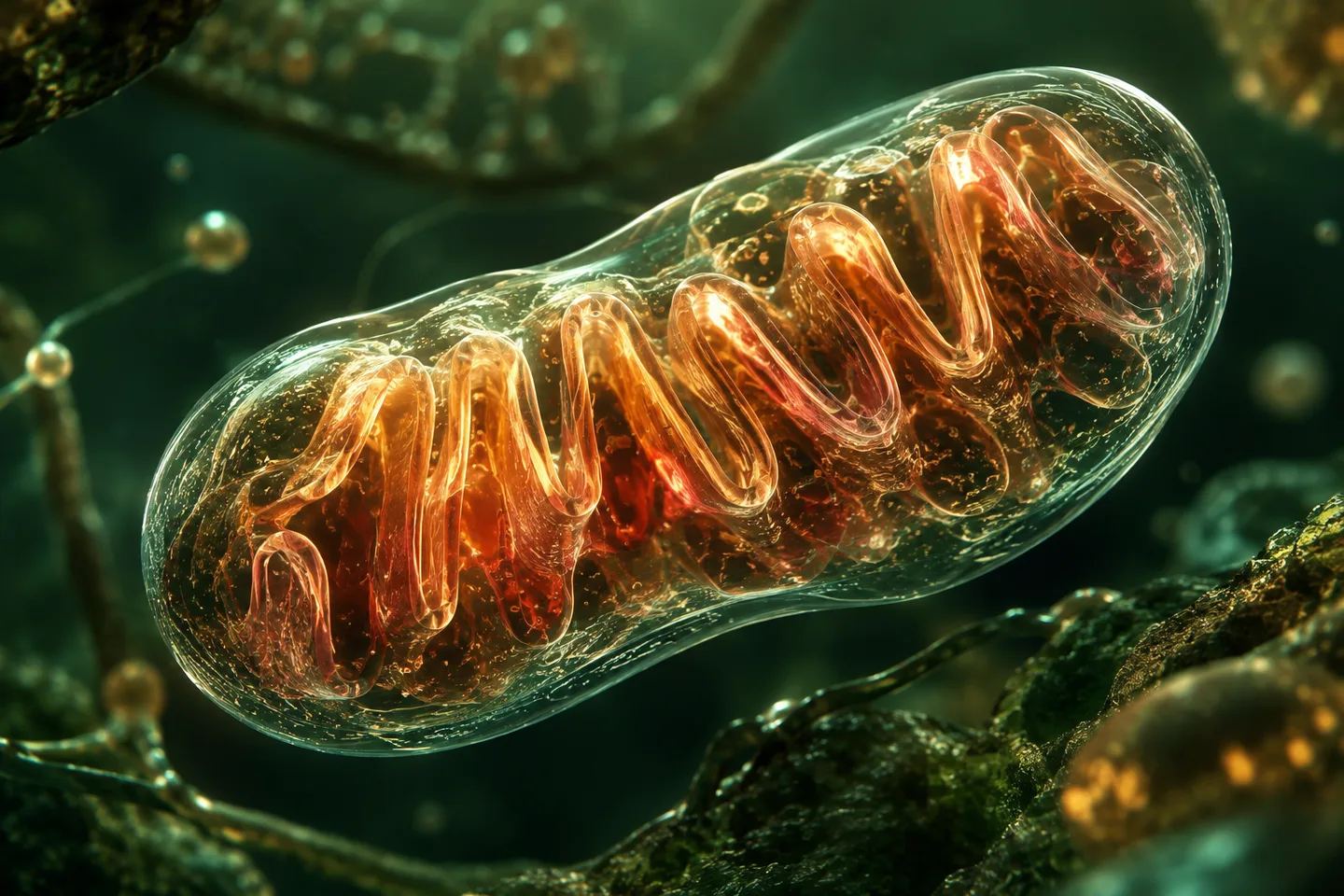
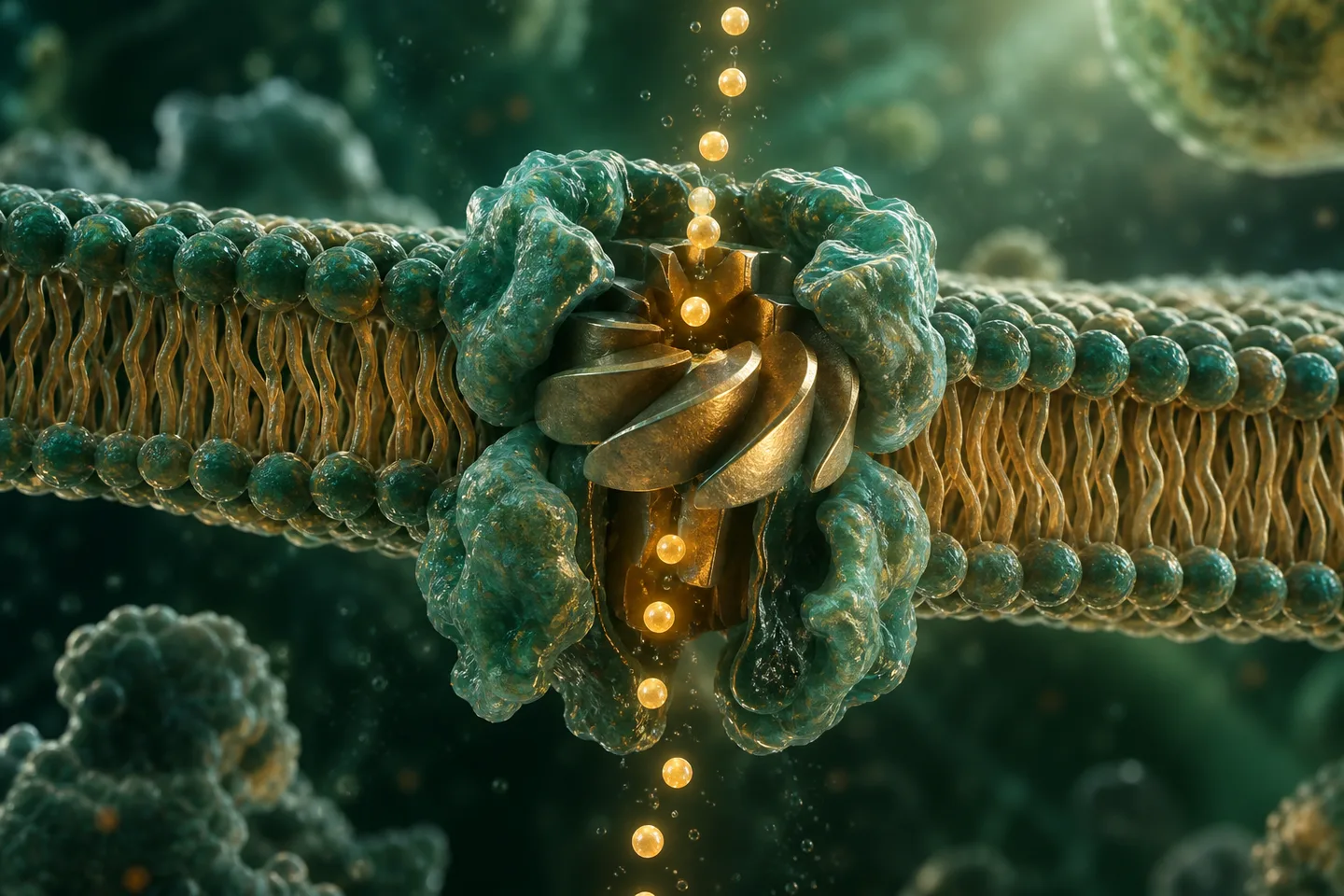
Olgun describes the proton gradient across the mitochondrial membrane and how ATP synthase harnesses it to produce ATP. He considers whether a deuteron, due to its different mass and transfer kinetics, could transiently alter the motion of the complex. The presentation develops a model in which isotope binding at a specific site might cause irregular motion or a brief pause. A mechanical analogy for the rotor is used to aid understanding of the hypothesis, but it is not a literal depiction of the process in a living cell.
16–24 min · Subunit C and duration estimates
Much of the argument centers on subunit C of the rotor. Olgun combines estimates of proton–deuterium encounter frequency with published data on mitochondrial protein half-lives. He calculates when multiple substitutions might occur simultaneously and asks whether the protein would be degraded before the effect accumulates. Some numbers are difficult to extract reliably from the automated transcript, so the article does not convert them into firm predictions. The core idea is a model-based prediction; the actual subunit lifetime and functional consequences should be measured directly.
24–32 min · Animal models, erythrocytes, and NAD
The presentation discusses experiments with heavy water in animals and the sensitivity of certain tissues to concentrations far exceeding those found in drinking water. Olgun proposes erythrocytes and hemoglobin as accessible models for studying hydrogen exchange and long-term exposure. He draws an analogy to HbA1c, which reflects prior glycemic levels, and speculates about deuterium-labeled compounds and the NAD pool. These are suggestions for measurement and possible mechanisms; the presentation does not validate a clinical test for consumers.
32–40 min · Lysosomes, antiviral response, and future experiments
Olgun returns to lysosomal pH and V-ATPase, comparing its function to that of ATP synthase: one uses ATP to pump protons, the other uses the gradient to produce ATP. He discusses potential contacts between mitochondria and lysosomes and asks whether protons might shuttle between compartments. Toward the end, he links mitochondrial hypotheses to interferons and the antiviral response in the context of COVID-19, suggesting that reducing deuterium levels might influence this response. This suggestion constitutes no evidence for prevention or treatment of infection and is not a medical recommendation.
How the rotor calculation is constructed
Olgun builds the hypothesis starting from the proton flux through ATP synthase and the circular arrangement of subunit C in the rotor. He estimates how often a deuteron might occupy a relevant position and asks whether two closely spaced events could temporarily halt rotation. He then compares this frequency to estimates of protein half-life. The calculation relies on assumptions: isotope availability, local reaction kinetics, binding probability, and the mechanism of subunit replacement. The automated transcript yields some values unstably, so we do not present these numbers as measured predictions. The core of the presentation is a testable model, not a demonstration of ATP synthase stalling in a human.
From ATP synthase to V-ATPase
The presentation compares two related complexes with distinct functions. ATP synthase uses the proton gradient to drive ATP synthesis; V-ATPase consumes energy to pump protons into compartments such as lysosomes. Olgun suggests that deuteronation could perturb both systems and discusses possible consequences for lysosomal pH and aging. Structural similarity does not prove identical functional responses. Tests should measure each complex separately under defined conditions and determine whether pH changes actually alter cellular function.
Models for the next experiment
Near the end, Olgun proposes measuring subunit C half-life, differences between native and substituted forms, and potential changes in NAD. He highlights erythrocytes and hemoglobin as accessible models for repeated longitudinal measurements, drawing an analogy to HbA1c. Such a proposal must be analytically validated before being used as an exposure biomarker. Animal studies using highly deuterated water provide different information and cannot be equated with minor variations in drinking water. These proposals indicate what is missing to move from calculation to reproducible observation.
Antiviral response: hypothesis, not recommendation
In the context of the 2021 pandemic, Olgun discusses interferons and suggests that altering the mitochondrial environment might influence the antiviral response. He cites a paper on a dietary compound and an immune marker, then asks whether reduced-deuterium water might produce a similar effect. This analogy does not demonstrate prevention or treatment of COVID-19, nor does it constitute dietary advice. Claims about infections require clinical trials designed specifically for that outcome, not merely parallels between cellular pathways.
Probability calculation and its limitations
Olgun’s reasoning relies on a sequence of assumptions: which isotope reaches the reaction site, how frequently it interacts with a specific subunit, how long it remains there, and what functional change it might produce. Even if each step seems plausible, their combined effect could substantially alter the final estimate. The transcript discusses a numerical model, but the automated transcription renders part of the numerical data and names unreliably. Consequently, the article outlines the argument’s structure without reconstructing uncertain values. Testing it would require experiments in which these parameters are measured separately, followed by functional assays of the complex under identical conditions.
From hypothesis to a test that could falsify the model
A useful experiment would not merely seek confirmation of the idea but would also specify the outcome that would refute it. For the rotor hypothesis, ATP synthase activity could be compared under defined isotopic conditions, with direct measurement of composition and function. For V-ATPase, it must be determined separately whether proton pumping or the compartment’s cellular environment changes. For erythrocytes and hemoglobin, it must first be validated whether the method detects a relevant change with sufficient precision and reproducibility. The presentation lists experimental avenues but does not indicate that these tests have already confirmed effects on aging or immunity.
What the hemoglobin analogy means
Olgun uses hemoglobin and erythrocytes as examples of components that could be monitored over time, drawing an analogy to how other blood-based biomarkers are tracked. The analogy suggests a possible sampling strategy but does not demonstrate that hemoglobin records deuterium exposure in a manner already validated. It must be established what molecule is measured, how long the signal persists, how much it varies among individuals, and whether the result correlates with the water’s deuterium content. The presentation frames this idea as a research direction, not as a diagnostic test currently available.
The proposed link between mitochondria and immune response
The final section introduces interferons and the antiviral response, following the explanation of the proton gradient and ATP synthase. The argument posits that altered mitochondrial function could downstream affect cellular signaling. However, a hypothesis about a pathway does not indicate whether an intervention changes infection risk, disease severity, or duration. Such outcomes must be measured separately, in a clinical study designed specifically for them. In the article, this sequence is included to fully map the subject area, with the explicit caveat that it offers no medical advice and does not prove prevention or treatment of COVID-19.
Testing a model without presupposing its conclusion
The presentation leaves open a working pathway: quantifying subunits, testing enzyme function, measuring biomarkers, and comparing animal models with human tissues. These are distinct experiments that should be reported separately, with results capable of falsifying the hypothesis. A laboratory finding would not automatically validate extrapolation to the whole organism, nor would a blood biomarker alone indicate an effect in an individual. This framework preserves the presentation’s contribution—the formulation of testable hypotheses—without attributing a conclusion unsupported by the data presented.
The article is a thematic synthesis of the DDS 2021 presentation, not a full transcript. Minute markers are approximate, and automated transcription may contain errors in names or numbers. Speakers’ statements are not automatically validated independent results. Seethe DDS 2021 11-materials guide.
Published on 12 September 2026. Documented updates on 23 September 2026. Event information may be updated by organizers.