Starting point
Chris Shade opens the presentation with a conceptual map called the “longevity wheel.” He states that age-related decline cannot be reduced to a single cause or a single supplement, and proposes examining multiple systems simultaneously.
Mitochondria in the discourse
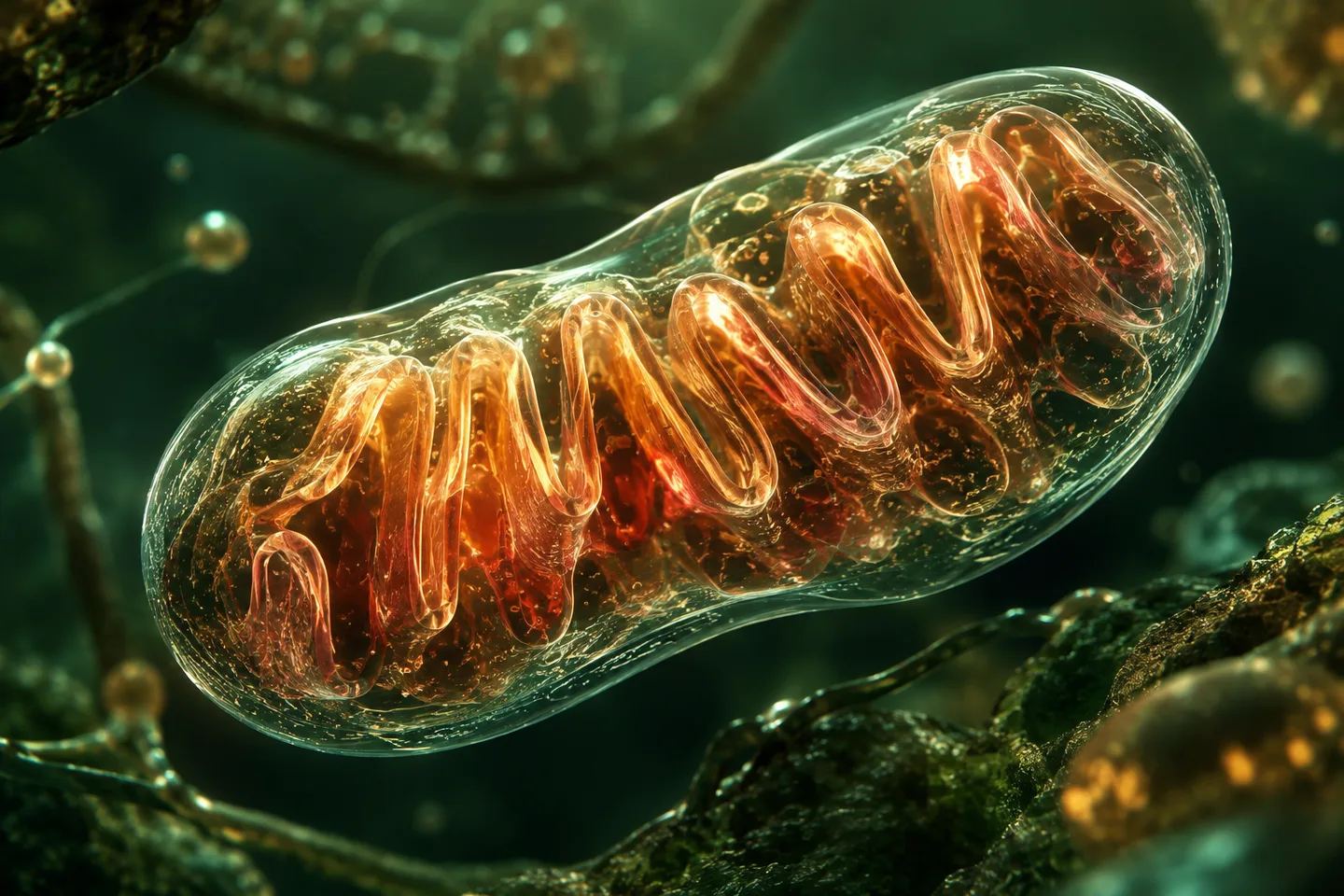
In the transcript, mitochondria appear as a central node in the discussion of cellular energy. Energy production, the electron transport chain, reactive species control, and mitochondrial biogenesis are mentioned. These are concepts from cell biology, not an evaluation of a product.
Other “spokes”
Shade lists pathways such as AMPK, NRF2, sirtuins, NAD, telomeres, senolytics, and the hypothalamic–pituitary–adrenal axis. The listing reflects the breadth of the subject but does not establish that activating a pathway via supplements extends human lifespan.
Proteins and cellular recycling
A portion of the presentation addresses the response to misfolded proteins and the mechanisms by which cells eliminate waste. The overarching idea is that cellular health depends not only on adding substances but also on maintenance. For each mechanism, precise definitions and measurements are required.
Practical limit
The presentation can be read as a map of questions, not as a protocol. We do not extract supplement doses or combinations. A laboratory result, a cellular intervention, and a clinical outcome represent different levels of evidence.
Cellular cleanup and the concept of maintenance
Shade uses the image of pages discarded by a writer to explain the accumulation of substances requiring management. In the journal’s interpretation, the analogy is useful as it links molecule production to system maintenance. Nevertheless, it has limitations: a cell employs multiple signaling and recycling pathways, and a single intervention may affect several processes. We cannot translate the metaphor into a supplement regimen without knowing what was measured and under what conditions.
A map of mechanisms is not a ranking
Themes such as AMPK, NRF2, NAD, and senescence are presented together to suggest interdependence. Their order on a slide does not indicate priority for an individual, nor does it reflect the relative strength of the evidence. For each statement, the reader can distinguish three questions: Is a mechanism described? Is a biomarker altered? Is there a meaningful outcome for participants? This approach preserves interest in cell biology while preventing conflation of results addressing different questions.
00–08 min · Longevity wheel
Chris Shade structures his presentation around a “longevity wheel,” with mitochondria at the center and several cellular pathways arranged around it. He lists AMPK, NRF2, sirtuins, NAD, telomeres, senolytics, and the stress-hormone axis. The map conveys the speaker’s view that aging cannot be reduced to a single supplement or biomarker. The listing does not imply that all pathways have equal levels of evidence, nor that altering them via a product extends lifespan.
08–16 min · Mitochondria, telomeres, and maintenance pathways
Shade moves from schematic to the pathways he considers linked to mitochondrial maintenance. He discusses the relationship between AMPK and mTOR, growth phases versus periods when the cell activates repair mechanisms. Telomeres also appear here, along with the question of how signals from one chromosomal region might influence other processes. The speaker connects these pathways to nutraceuticals, but the discussion does not establish a universally appropriate protocol. The explanation should be read as Shade’s model for organizing the topic, not as a supplementation guide.
16–24 min · mTOR, AMPK, and sirtuins
The presentation develops the alternation between growth-associated signals and those associated with resource conservation or cellular recycling. Shade discusses mTOR and AMPK, then moves on to sirtuins and the measurement of their total and active forms. He cites studies and intervention examples to link these pathways to mitochondrial function. However, a blood biomarker, a cellular mechanism, and a clinical outcome are distinct questions; the same marker change does not demonstrate increased longevity.
24–32 min · NAD and nucleus–mitochondria communication
Shade describes NAD as part of multiple reactions and discusses the relationship between the NAD⁺/NADH ratio and metabolic activity. He then uses TFAM and mitochondrial biogenesis to address communication between the nucleus and mitochondria. These concepts explain why cellular metabolism is interconnected, yet the presentation does not provide a clinical measurement through which one could infer an individual’s status or supplement dosage. Claims regarding interventions remain those of the speaker and require separate evaluation.
32–40 min · Senescence, telomeres, and cellular clearance
The discussion shifts to telomeres, senescent cells, and pathways for eliminating damaged components. Shade describes senolytics as a category of interventions under study and relates them to inflammation and mitochondrial function. The presentation’s sequence does not demonstrate that any particular intervention prevents aging in humans. These terms aid in following the slides, but each effect should be tied to the specific study, tissue, and measured outcome.
40–48 min · Adaptogens and formulation considerations
In the second half, Shade shifts focus toward products and nutraceutical combinations. He discusses adaptogens and the cortisol response, then lists ingredients and commercial formulations. This segment is part of the recording and should be viewed as such: the presentation includes both mechanistic explanations and sales context. We do not present the combinations as a schema for readers, as the recording does not establish individual indications, interactions, or safety profiles.
48–56 min · Methylation and cofactors
Shade returns to NAD and methylation pathways, covering homocysteine, methionine, MTHFR, and vitamins or cofactors involved in these processes. He links biochemical reactions to proposed formulations aimed at supporting specific cellular pathways. A plausible mechanism alone is insufficient to recommend a combination; studies specifying the population, doses, comparator, and outcomes would be required. This segment also includes examples of capsules or administration forms, treated here as part of the commercial presentation.
56–61 min · Conclusion and practical limitations
In the final minutes, the speaker reviews other compounds and reiterates the general idea of considering multiple pathways simultaneously. The conclusion does not rank interventions nor offer any clinical assessment of reduced-deuterium water. The useful editorial insight is to read each level separately: mechanism, biomarker, individual outcome, and commercial claim. The presentation provides a map of questions and product examples—not individual recommendations.
Why are multiple pathways placed in the same framework?
Shade’s Wheel integrates AMPK, mTOR, NRF2, sirtuins, NAD, telomeres, senescence, and hormonal signaling. His premise is that cellular processes mutually influence one another, and supplementing a single compound does not automatically resolve age-related decline. This network-style presentation aids in organizing terminology but does not indicate that each pathway holds equal clinical relevance or that all must be "activated." To evaluate a claim, it must be noted whether the result pertains to a biochemical reaction, a biomarker, tissue function, or a meaningful change for participants.
NAD, cellular communication, and mitochondrial biogenesis
Shade uses NAD and the nucleus–mitochondria relationship to explain why metabolism involves numerous components. He introduces TFAM and mitochondrial biogenesis, then connects these themes to sirtuins and senescence. A mechanistic description may explain why researchers track a particular marker, but it does not prove that administering an ingredient restores function or extends lifespan. Measurements from blood, cell cultures, and clinical outcomes are not directly interchangeable. In the article, each statement about supplements remains attributed to the presenter.
The commercial portion of the presentation
A substantial segment of the talk lists nutraceuticals, formulations, and administration routes. This sequence should not be omitted when summarizing the material: the audience receives both a map of mechanisms and a product overview. We do not reproduce such lists as protocols, as the talk does not establish for each ingredient its indication, interactions, contraindications, or adverse effects. Nor does the general link between mitochondria and longevity demonstrate that a commercial formulation yields the promised outcome. The article preserves the commercial context and separates it from the experimental data cited.
How Shade organizes metabolic pathways
Shade’s schematic begins with mitochondria and links energy-sensing pathways, antioxidant responses, metabolic regulation, and cellular aging. In the discussion, AMPK and mTOR appear as examples of signaling molecules with distinct roles in metabolism; NAD and sirtuins emerge in relation to cellular reactions; senescence and telomeres extend the narrative toward cellular maintenance. The schematic is useful as a conceptual map of the terms invoked, but it does not demonstrate that a single intervention influences all these pathways in the same direction. An article reproducing such a schematic must clarify for each statement whether the speaker cites a mechanism, a marker, or an observed human outcome.
Where the tone shifts toward products
A significant portion of the recording transitions from explaining biological pathways to listing ingredients, formulations, and administration routes. This shift does not negate the educational segment but changes its purpose: biochemical examples are followed by commercial proposals. The article notes this to enable readers to assess the presentation’s context and intent. We do not convert the ingredient inventory into a shopping list or protocol; dosing, contraindications, interactions, or clinical outcomes are not systematically discussed for each product in the recording. A plausible mechanism may justify a study, but by itself, it does not constitute evidence that a formulation extends lifespan.
Mechanism, marker, and participant outcome
Shade’s presentation draws on concepts from multiple levels: metabolic pathways such as AMPK and mTOR, signaling molecules like NAD, markers such as telomeres, and broader ideas about age-related functional decline. When plotted on the same framework, these may appear as a direct chain, yet each requires its own measurement and type of evidence. A change in one marker does not automatically signify a change in an organ’s function, nor does such a change necessarily translate into extended lifespan. The article follows the presenter’s conceptual map but does not conflate these findings into a single promise of longevity.
This article is a thematic synthesis of the DDS 2021 presentation, not a full transcript. Timestamps are approximate, and automated transcription may contain errors in names or numbers. Speakers’ statements are not automatically validated independent results. See theDDS 2021 11-material guide.
Published on 12 September 2026. Documented updates on 23 September 2026. Event information may be updated by organizers.